Search is changing quickly.
How to Dominate Google & AI Search Results in 2026: A Complete SEO Guide /seo-ai-search-results-2026/
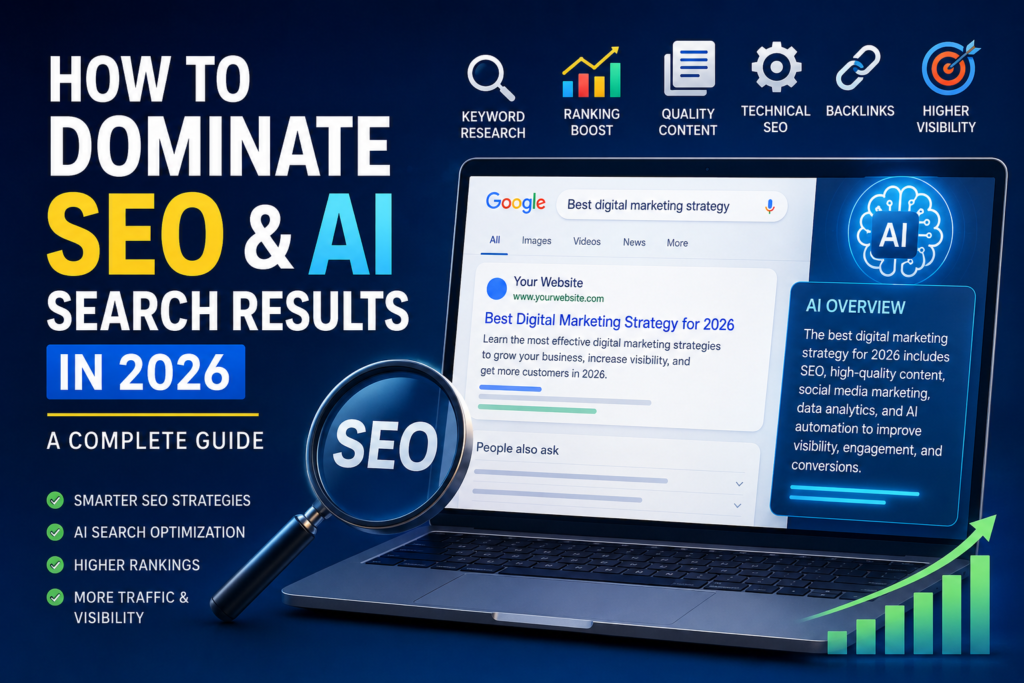
People are no longer using search engines only to find a list of websites. They are also using AI-powered search tools to ask questions, compare options, find products, and discover businesses.
Because of this change, businesses need a modern SEO strategy that works for both Google search and AI search.
In 2026, SEO is not only about adding keywords to a website. It is about creating useful content, building trust, improving the website experience, and giving people clear answers to their questions.
If you want your website to get more organic traffic and become more visible in Google and AI search results, you need to understand how modern SEO works.
This guide explains the most important SEO strategies you can use in 2026.
https://sudhiradspro.com/wp-admin/post.php?post=26&action=edit
What Is SEO in 2026?
SEO stands for Search Engine Optimization.
It is the process of improving your website so that search engines can understand your content and show your pages to people who are looking for your products, services, or information.
SEO in 2026 is broader than traditional keyword optimization.
A modern SEO strategy includes:
- Keyword research
- Search intent
- Helpful content
- On-page SEO
- Technical SEO
- Internal linking
- Website speed
- Mobile optimization
- Local SEO
- Backlinks
- Structured data
- E-E-A-T
- AI search optimization
- Content quality
The main goal is simple:
Create the best possible answer for the person searching for information.
When your website is useful, easy to understand, technically strong, and trustworthy, you give search engines more reasons to show your content.
Why Google and AI Search Matter in 2026
Google is still an important source of website traffic, but the way people search is changing.
AI-powered search can understand longer and more detailed questions. Instead of searching for a few words, users can ask complete questions and expect a direct answer.
For example, a person may search:
“What is the best digital marketing strategy for a small business?”
This type of search is different from simply searching:
“Digital marketing strategy.”
The first question shows a clear problem and a specific need.
This is why businesses need to create content that answers real questions instead of simply targeting individual keywords.
Your content should help people understand:
- What something is
- Why it matters
- How it works
- How to use it
- What mistakes to avoid
- What solution may work best
This approach can help your website become more useful in both traditional and AI-driven search.
1. Understand Search Intent Before Writing
One of the most important parts of SEO is understanding search intent.
Search intent means the reason behind a search.
For example, someone searching for:
“What is SEO?”
probably wants information.
Someone searching for:
“SEO agency near me”
may be looking for a service provider.
Someone searching for:
“SEO services pricing”
may be comparing different options before making a decision.
There are four common types of search intent.
Informational Intent
The user wants to learn something.
Examples:
- What is SEO?
- How does keyword research work?
- What is technical SEO?
Navigational Intent
The user wants to find a particular website or brand.
Examples:
- Google Search Console
- Google Ads
- Sudhir Ads Pro
Commercial Intent
The user is researching before buying.
Examples:
- Best SEO agency
- SEO services for small business
- SEO agency vs freelancer
Transactional Intent
The user is ready to take action.
Examples:
- Hire SEO agency
- Buy SEO services
- SEO consultation
Before writing an article, always ask:
What does the person actually want to know?
Once you understand the answer, your content becomes much easier to create.
2. Choose the Right Keywords
Keywords are still important for SEO.
However, modern SEO is not about repeating the same keyword again and again.
Instead, you should understand the main topic and the related questions people search for.
For example, if your main topic is:
SEO in 2026
you can also cover related topics such as:
- SEO trends in 2026
- AI SEO
- AI search optimization
- Google ranking
- keyword research
- technical SEO
- on-page SEO
- content optimization
- local SEO
- link building
- E-E-A-T
- search visibility
These related topics help you create a complete resource.
Use Keywords Naturally
Do not write:
SEO in 2026 is important because SEO in 2026 helps SEO in 2026 websites improve SEO in 2026 rankings.
That sounds unnatural.
Instead, write naturally:
SEO is becoming more important as Google and AI-powered search continue to change the way people find information online.
The second sentence is easier to read and still communicates the topic clearly.
3. Build Topical Authority
Topical authority means showing that your website understands a subject in depth.
For example, if your website provides digital marketing services, you should not publish only one article about SEO.
You can create several useful articles around the same subject.
Main Guide
Complete SEO Guide for 2026
Supporting Articles
- Keyword Research Guide
- Technical SEO Guide
- On-Page SEO Guide
- Local SEO Guide
- Link Building Guide
- SEO Audit Guide
- AI SEO Guide
- Content Marketing Guide
- Google Search Console Guide
- E-E-A-T Guide
Then connect these pages with internal links.
This creates a strong topic structure.
It also makes it easier for visitors to find more information on your website.
4. Write for People First
One of the biggest mistakes in SEO is writing only for search engines.
Your first priority should always be the reader.
Good content should be:
- Simple
- Useful
- Clear
- Original
- Accurate
- Easy to read
- Well organized
- Relevant to the topic
Avoid unnecessary words.
Avoid repeating the same idea.
Avoid using complicated language when a simple sentence can explain the same thing.
For example:
Instead of:
“Businesses should strategically leverage comprehensive optimization methodologies.”
Write:
“Businesses should use a clear SEO strategy to improve their online visibility.”
Simple writing is easier for people to understand.
5. Make Your Content Easy for AI Search to Understand
AI search systems need to understand your content clearly.
You can make your articles easier to understand by using a simple structure.
Use:
- Clear headings
- Short paragraphs
- Direct answers
- Bullet points
- Numbered lists
- Examples
- Definitions
- FAQs
For example:
What Is Technical SEO?
Technical SEO is the process of improving the technical parts of a website so search engines can crawl, understand, and index its pages properly.
Then explain the topic in more detail.
This structure helps readers find the information they need quickly.
6. Answer Questions Clearly
People often search using questions.
For example:
- What is SEO?
- How does SEO work?
- How can I rank higher on Google?
- How can I improve my website traffic?
- What is AI search?
- How does technical SEO work?
Create sections that answer these questions directly.
A useful format is:
Question → Short answer → Explanation → Example → Action
This makes your content simple and useful.
It can also make important information easier for search systems to understand.
7. Create Helpful and Original Content
There is a huge amount of content online.
If your article simply says the same things as hundreds of other websites, it may be difficult to stand out.
Try to add something original.
You can include:
- Your experience
- Your own examples
- Case studies
- Original research
- Screenshots
- Industry insights
- Step-by-step instructions
- Practical tips
For example, instead of simply explaining keyword research, you could show how you personally research keywords for a real website.
This makes the article more useful and more human.
8. Focus on E-E-A-T
E-E-A-T stands for:
Experience
Expertise
Authoritativeness
Trustworthiness
These concepts are important when building high-quality content.
Your website should make it clear that the information comes from a reliable source.
You can improve trust by having:
- An author name
- An About page
- A Contact page
- Clear business information
- Accurate information
- Reliable sources
- Customer reviews
- Case studies
- Secure HTTPS
- Professional website design
If you make a claim, explain it clearly.
For example, don’t simply say:
“Our SEO strategy increased traffic by 200%.”
Explain what was done, how long it took, and what was measured.
Specific information makes your content more trustworthy.
9. Improve Technical SEO
Good content is important, but your website also needs a strong technical foundation.
Technical SEO helps search engines access and understand your website.
Important areas include:
Website Crawling
Make sure search engines can access important pages.
Website Indexing
Check that your important pages can be indexed.
Mobile Optimization
Your website should work well on mobile phones and tablets.
Website Speed
Slow websites can create a poor user experience.
Compress large images, remove unnecessary scripts, and improve your website’s performance.
HTTPS
Use a secure HTTPS connection.
XML Sitemap
Keep your XML sitemap updated so search engines can discover important pages.
Website Structure
Create a simple website structure.
For example:
Homepage → Service Page → Topic Page → Blog Article
A clear structure helps both users and search engines navigate your website.
10. Improve User Experience
SEO is not only about search engines.
Your website should also be easy for people to use.
When someone visits your website, they should quickly understand:
- What your business does
- What services you provide
- Who you help
- Why they should trust you
- What they should do next
Make your website:
- Easy to navigate
- Mobile friendly
- Fast
- Easy to read
- Visually clean
- Simple to understand
Good SEO and good user experience should work together.
11. Use Internal Links
Internal linking is a simple but powerful SEO technique.
An internal link connects one page of your website to another page on the same website.
For example, if you write an article about SEO, you can link to your articles about:
- Keyword research
- Technical SEO
- On-page SEO
- Local SEO
- Content marketing
Use descriptive anchor text.
Instead of:
Click here
write:
Learn more about keyword research
This gives readers more information and helps them move around your website.
12. Earn High-Quality Backlinks
Backlinks are links from other websites to your website.
Relevant and trustworthy backlinks can help strengthen your website’s authority.
But you should not focus on getting hundreds of random links.
Focus on earning useful links from relevant websites.
You can do this by creating:
- Original research
- Industry reports
- Useful guides
- Free tools
- Templates
- Statistics pages
- Original studies
When your content provides real value, other websites have a reason to mention it.
13. Optimize for Local SEO
If you provide services in a specific city or area, local SEO can help you reach nearby customers.
For example, a digital marketing business can create useful content around:
- Digital marketing services
- SEO services
- Local SEO
- Google Business Profile
- Marketing for local businesses
Keep your business information consistent across important platforms.
Also focus on genuine customer reviews and useful local content.
Avoid creating many low-quality location pages that contain almost the same information.
14. Use AI as a Tool, Not a Replacement for People
AI can make content creation faster.
You can use AI for:
- Ideas
- Research organization
- Outlines
- Content planning
- Editing
- Summaries
- Brainstorming
But don’t depend on AI to create hundreds of generic articles without checking them.
Your content should have a human touch.
Add your own:
- Experience
- Opinions
- Examples
- Research
- Case studies
- Insights
The goal should be to create content that is useful and original, not simply content that was generated quickly.
15. Optimize for Long-Tail Searches
Long-tail keywords are longer and more specific search phrases.
For example:
Short keyword:
SEO
Long-tail keyword:
How can a small business improve SEO in 2026?
Long-tail searches often show a clearer need.
Create content that answers specific questions from your target audience.
This can help you attract visitors who are looking for exactly what you offer.
16. Improve Your Title and Meta Description
Your title tells users and search engines what your page is about.
For this article, a strong title is:
How to Dominate Google & AI Search Results in 2026: A Complete SEO Guide
Your meta description could be:
Learn how to improve Google rankings and increase visibility in AI search with simple SEO strategies, helpful content, technical SEO, keyword research, and more.
Keep your title and description clear.
Don’t add keywords simply for the sake of adding them.
17. Keep Your URLs Simple
Your URL should be short and easy to understand.
For this article, a simple URL could be:
/seo-ai-search-results-2026/
Avoid very long URLs with unnecessary words.
A clean URL helps users understand what the page is about.
18. Update Old Content
SEO is not a one-time task.
Your old content can become outdated.
Review your important articles regularly.
Check for:
- Old statistics
- Broken links
- Outdated information
- Old screenshots
- Missing topics
- New search trends
- New internal linking opportunities
If an article is still useful, improve it instead of always creating a completely new article.
Updating good content can help keep it useful for your audience.
19. Track Your SEO Results
You cannot improve what you do not measure.
Use tools such as Google Search Console and Google Analytics to understand how your website is performing.
Track:
- Organic traffic
- Search impressions
- Clicks
- Click-through rate
- Keyword visibility
- Leads
- Conversions
- Top-performing pages
Don’t focus only on rankings.
A keyword ranking is useful, but the real goal is to attract the right people and generate business.
20. Create a Simple SEO Strategy for 2026
You don’t need a complicated plan to start.
Follow these steps.
Step 1: Understand Your Audience
Find out what your customers want and what problems they have.
Step 2: Research Keywords
Find the words and questions your audience uses when searching online.
Step 3: Understand Search Intent
Make sure your content matches what people actually want.
Step 4: Create Useful Content
Write clear and original articles that solve real problems.
Step 5: Improve Your Website
Fix technical SEO issues, improve speed, and make the website mobile friendly.
Step 6: Build Internal Links
Connect related pages together.
Step 7: Build Authority
Earn relevant mentions and backlinks naturally.
Step 8: Measure Results
Check your traffic, visibility, leads, and conversions.
Step 9: Improve
Keep updating your website and content based on what you learn.
Common SEO Mistakes to Avoid in 2026
Even good websites can make SEO mistakes.
Here are some common problems to avoid.
1. Keyword Stuffing
Do not repeat the same keyword again and again.
Write naturally.
2. Copying Competitors
Don’t simply rewrite what other websites have already published.
Add your own value.
3. Publishing Low-Quality AI Content
AI can help you work faster, but every article should be reviewed and improved by a human.
4. Ignoring Search Intent
If your content does not answer the user’s real question, rankings can be difficult to achieve.
5. Buying Poor-Quality Backlinks
Avoid low-quality or manipulative link-building practices.
6. Ignoring Technical SEO
Content alone cannot fix serious technical problems.
7. Writing Only for Rankings
Your website should help people, not just search engines.
SEO and AI Search: What Should You Focus on in 2026?
If you want to improve your visibility in Google and AI search, focus on these areas:
- Understand your audience
- Choose relevant keywords
- Match search intent
- Create helpful content
- Build topical authority
- Improve technical SEO
- Make your website easy to use
- Use internal links
- Earn relevant backlinks
- Show real experience and expertise
- Keep your content updated
- Measure and improve your results
You do not need to master everything on the first day.
Start with the basics and improve your website step by step.
Frequently Asked Questions
Is SEO still important in 2026?
Yes. SEO is still an important way for businesses to reach people who are actively searching for information, products, and services. The main difference is that search is becoming more intelligent and more conversational.
How can I rank higher on Google in 2026?
Start with search intent, useful content, keyword research, technical SEO, internal linking, website experience, and trustworthy information. There is no single trick that guarantees a top position.
What is AI search optimization?
AI search optimization means creating clear, useful, and trustworthy information that AI-powered search systems can understand and potentially use when answering user questions.
Are keywords still important?
Yes. Keywords help you understand what people are searching for. However, you should use them naturally and focus on the complete topic instead of repeating one keyword.
Can AI-generated content rank?
AI can be used as part of the content creation process. However, the content should provide real value, be accurate, and offer something useful to the reader. Human review and original insights are important.
How long does SEO take?
SEO results can take time and vary from website to website. Competition, website authority, technical issues, content quality, industry, and the SEO strategy all affect the timeline.
Final Thoughts
SEO in 2026 is not about finding a secret trick to reach the top of Google overnight.
It is about building a website that people can trust and use.
Create content that answers real questions.
Use keywords naturally.
Make your website fast and easy to use.
Build strong internal links.
Earn relevant backlinks.
Show your experience.
Keep your content updated.
Most importantly, focus on helping your audience.
Google and AI-powered search are becoming better at understanding what people want. Your SEO strategy should do the same.
If your website consistently provides clear, useful, and trustworthy information, you can build stronger search visibility over time.
The future of SEO is not about creating more content. It is about creating better content.
And that is the approach businesses should follow in 2026.